
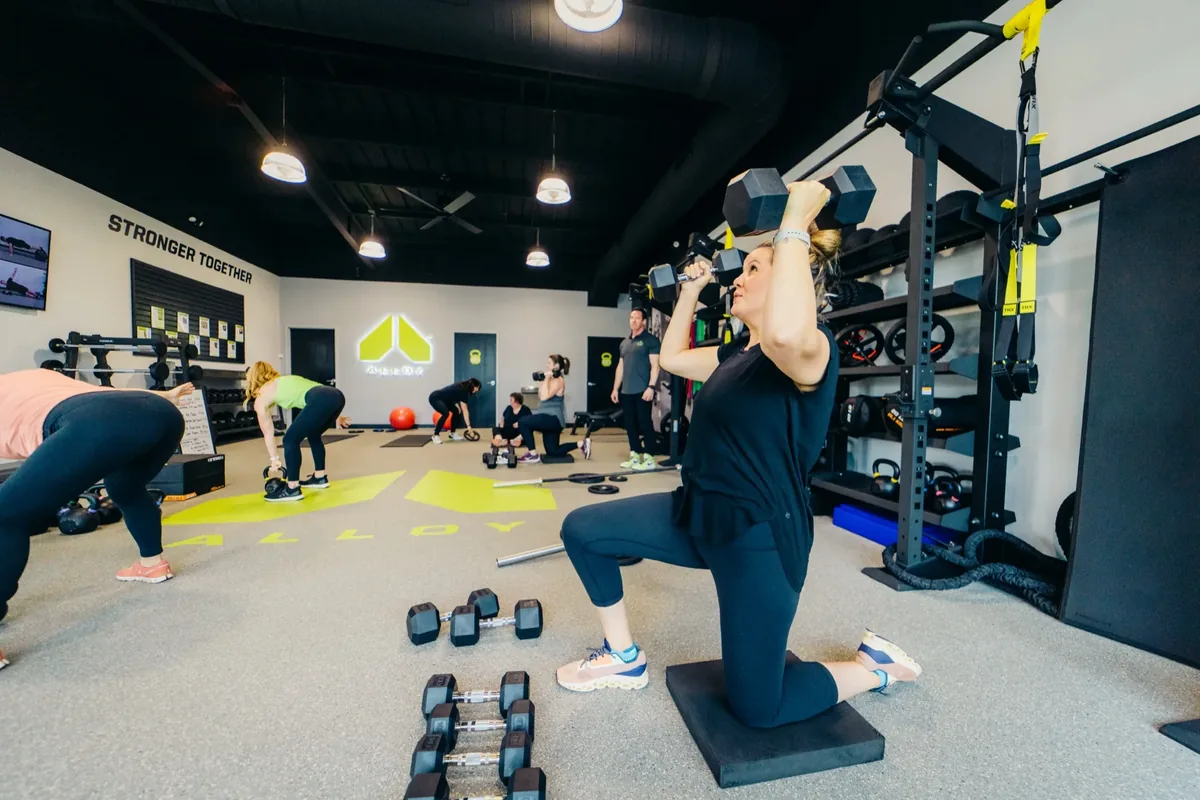
Six people train in a small group session at Alloy Personal Training Middleton, and six different programs run at once. The person beside you might be six months into a structured strength block while you are in your second week with a modified squat and a lighter hinge. Same room, same coach, same 50 minutes; different work. That is what "individualized" means here, and because it is the most common question we hear from people weighing a coached studio against a class, this post explains exactly how it works.
Where does an individualized program start?
With an assessment, before any workout. Every member begins with a complimentary VIP Session: a conversation about goals, health history, and training past, an InBody body composition scan, and a strength and mobility assessment where a coach watches you move through basic patterns. That hour is where the coach learns the things a program has to respect: the side that does more work, the shoulder that does not love overhead, the knee that wants a shorter range for now.
From that, the coach builds your program. Not a template with your name typed at the top, but a plan for your body, your level, and the frequency you can actually keep. A program that ignores the assessment is not a program; it is inventory.
What does one session actually look like for six people?
A coached session runs about 50 minutes and follows a structure that makes individual coaching possible in a group:
- A guided warm-up, shared by the room but scaled per person. Someone rehabbing a hip gets different prep than someone training for a half marathon.
- Strength work in supersets, typically paired exercises performed for several sets. This is where the six programs diverge. One member's pair might be a goblet squat and a row; another's, a split squat and a push-up from an incline; a third's, a loaded carry and a hinge pattern with a kettlebell.
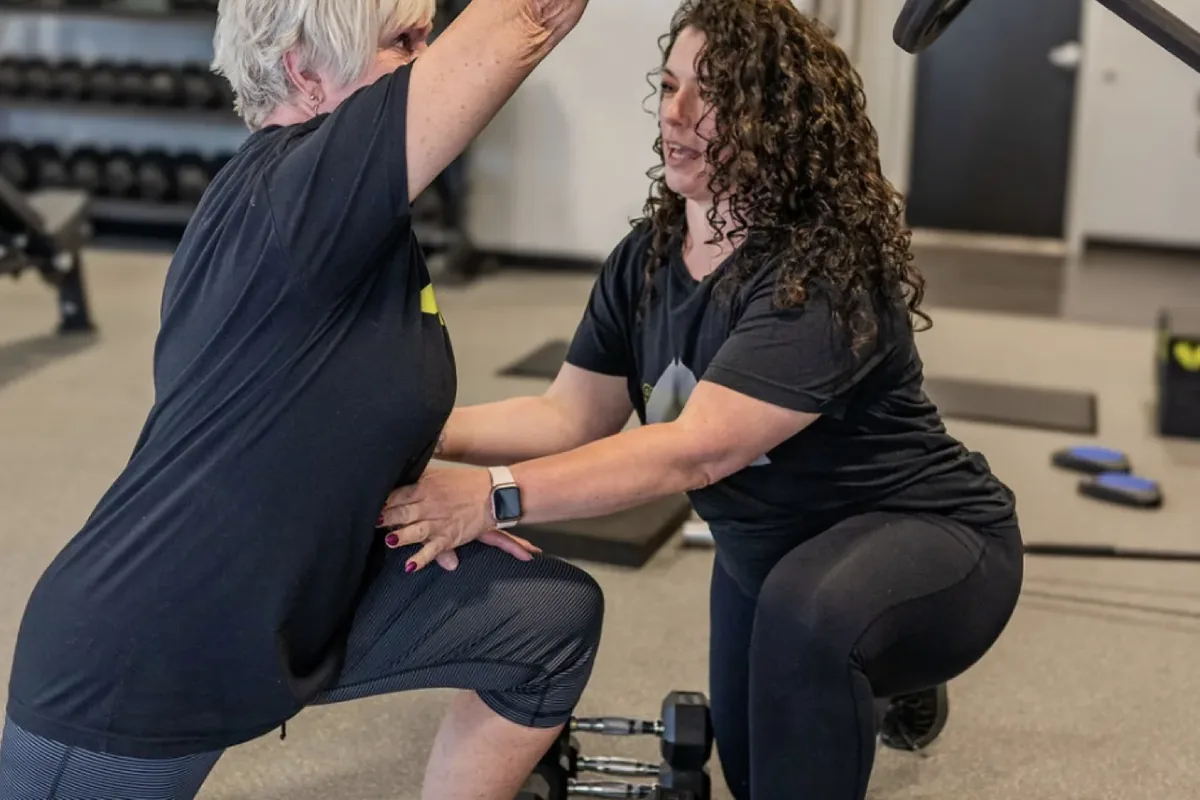
- Coaching throughout. While one member lifts, the coach is watching, setting up the next station, adjusting a weight, or cueing a movement. Nobody is waiting around and nobody is unsupervised.
- A finish matched to the person: conditioning for some, mobility for others, extra work on whatever a member specifically asked to improve.
The structure is the trick. Because the session is organized around paired movements and planned rest, the coach is always within a few feet of whoever needs a cue, and the room never turns into a class.
How does the coach modify in real time?
Three ways, and all three happen in nearly every session:
- Load. The weight goes up when the last set looked easy, and down when form started to slip. This is the most common adjustment and the one most people never get in a gym, because nobody is watching.
- Range and tempo. A shorter range of motion for a stiff joint, a slower lowering phase for someone learning a pattern, a pause at the bottom for someone who rushes.
- The exercise itself. If a movement does not fit your body that day, it gets swapped. A barbell becomes a pair of dumbbells; a floor press replaces a bench press; a step-up replaces a lunge. The goal is the same; the tool changes.
Members who have trained at big gyms often tell us the modification was what they were missing. Not because their old workouts were wrong, but because nobody was there to make the small change that kept a sore back from becoming a bad week.
Key Takeaway
Individualized small group training means six members, six programs, one coach. Each program starts from a Complimentary VIP Session assessment, runs inside a structured 50-minute session, and gets adjusted in real time on load, range, and exercise selection. The six-person cap is what makes the coaching real rather than a label.
Why not just do one-on-one training?
You can, and for some situations it is the right choice. The trade is frequency. One-on-one training tends to price most people down to a single session a week, and one session a week is the slowest path to getting stronger. Small group training shares the coach across six people, which brings the cost to a level where two or three sessions a week is realistic, and frequency is where results live.
The coaching does not thin out as much as people expect, because the session is built for it. You are still assessed individually, programmed individually, and corrected individually. What you give up is a coach's undivided stare for an hour. What you gain is a room full of people who learn your name and notice when you are gone, which does more for consistency than most members predict.
How do you know the program is working?
Because we measure it. Every member scans monthly on the InBody, so muscle mass and body fat percentage are tracked lines rather than impressions. Strength benchmarks get retested. The coach compares where you started with where you are, and the program changes based on what the data says: keep the hinge progression because it is working, back off the pressing volume because the shoulder is talking, add a carry because grip is lagging.
Most members notice changes in energy, strength, and confidence within the first few weeks of consistent training. Changes in body composition typically show over eight to twelve weeks. Long-term results come from consistency, and consistency comes from a program that fits you well enough to keep showing up for.
How do you get a program built for you?
Start where every member starts. Get Your Complimentary VIP Session at our studio at 8333 Greenway Blvd, Suite 140, just off the Beltline on Middleton's west side. The Complimentary VIP Session includes the goals conversation, the InBody scan, the strength and mobility assessment, and a small group training preview, and you leave with a customized plan built around how you actually move. You can read more about the format on our small group personal training page, or about how we program strength training for adults over 40.